


In midstream operations, reliability is not something you hope for. It is something you engineer into every component from the start.
Pipelines operate under constant pressure, changing temperatures, and demanding schedules. When a valve fails in the field, the consequences can be serious. Downtime, product loss, safety concerns, and expensive repairs can quickly follow.
That is why API 6D certification matters.
For pipeline operators, engineers, and procurement teams, API 6D certification represents more than compliance. It is a standard that helps ensure valves are built, tested, and proven for the environments they are expected to perform in every day.
What API 6D Certification Means
API 6D is a specification developed by the American Petroleum Institute for pipeline valves used in oil and gas applications.
The standard defines strict requirements for valve design, manufacturing, testing, inspection, and documentation. Valves that meet API 6D certification requirements are built specifically for pipeline service where performance and reliability are critical.
This includes several types of valves commonly used in midstream systems, including ball valves, gate valves, check valves, and plug valves.
In simple terms, API 6D certification helps verify that a valve is capable of handling the demands of real-world pipeline operations.
Why Midstream Operations Depend on Certified Valves
Midstream systems are responsible for transporting and storing massive volumes of oil and gas products across long distances. These operations depend on consistent flow control and dependable shutoff performance.
A single valve failure can disrupt operations across an entire section of pipeline infrastructure.
That is why certified pipeline valves are so important.
API 6D certified valves are designed to handle:
- High-pressure pipeline environments
- Temperature fluctuations
- Repetitive operating cycles
- Critical shutoff applications
- Long-term field performance
For operators, reliability is directly tied to safety, uptime, and operational efficiency. Certified valves help reduce uncertainty in the field and provide confidence that systems will perform when it matters most.
The Risk of Non-Certified Valves in Pipeline Systems
Not all valves are designed for pipeline service.
Using non-certified valves in midstream applications can introduce unnecessary risk, especially in high-pressure systems where performance requirements are demanding.
Potential issues may include:
- Premature seal failure
- Increased leak risk
- Higher operating torque
- Reduced service life
- Unplanned maintenance and downtime
In many cases, pipeline specifications require API 6D compliance from the start. Attempting to cut corners with non-certified products can create larger operational and financial problems later.
For midstream operators, reliability is not the place to compromise.
What API 6D Certification Verifies
API 6D certification is not based on marketing claims. It is backed by strict testing and inspection requirements that help ensure valves perform as intended.
The standard covers several key areas, including:
Design Requirements
Valves must meet defined engineering and dimensional standards intended for pipeline service applications.
Pressure and Leak Testing
Each valve is tested to verify sealing performance and structural integrity under pressure.
Material Verification
Materials must meet specified requirements to ensure durability and compatibility with demanding operating conditions.
Inspection and Quality Control
Manufacturing processes are subject to inspection procedures designed to maintain consistency and reliability.
Traceability and Documentation
API 6D certified valves include documentation and traceability that support quality assurance and compliance requirements.
Together, these standards help create a higher level of confidence for operators and procurement teams alike.
API 6D and Ball Valve Performance
Ball valves play a major role in midstream operations due to their reliable shutoff capability and operational efficiency.
Both floating ball valves and trunnion-mounted ball valves can be manufactured to API 6D standards depending on the application requirements.
Floating ball valves are commonly used in smaller sizes and moderate-pressure applications, while trunnion ball valves are often preferred for larger diameters and higher-pressure systems where reduced operating torque is important.
Regardless of the design, API 6D certification helps ensure the valve has been engineered and tested specifically for pipeline service.
Why Certification Matters in Procurement
For procurement teams and project engineers, API 6D certification simplifies the evaluation process and helps reduce risk during equipment selection.
Certified valves provide:
- Compliance with pipeline specifications
- Confidence in testing and quality standards
- Consistency across projects
- Easier documentation and traceability
- Greater long-term reliability
In high-demand industries where downtime can be extremely costly, selecting certified equipment is often the smarter long-term investment.
It is not just about purchasing a valve. It is about protecting the integrity of the entire operation.
Built for Midstream Reliability
Midstream operations require equipment that can perform under pressure day after day in real-world environments.
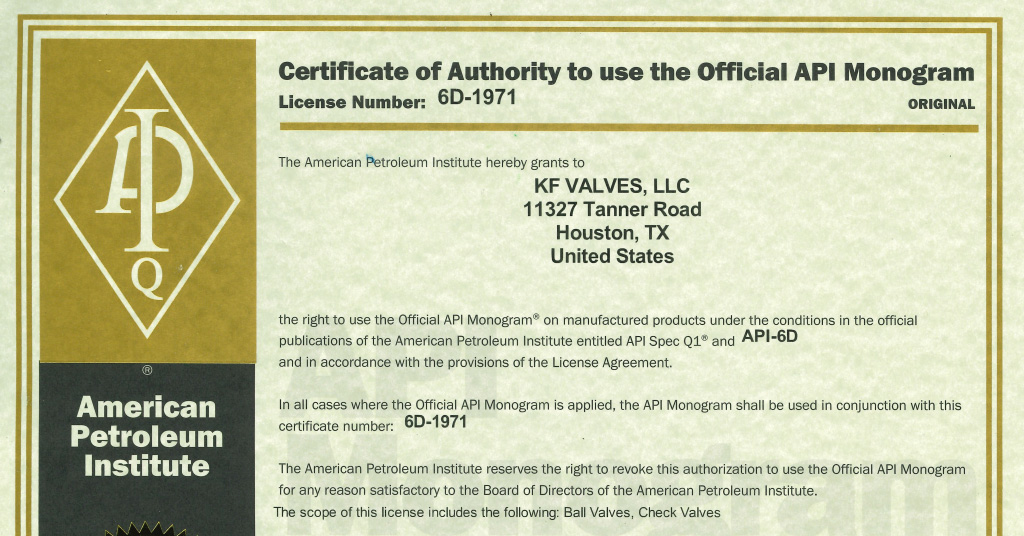
At KF Valves, API 6D standards are part of the foundation behind every pipeline valve solution we provide. From assembly and testing to final inspection, the focus remains on delivering reliable performance for demanding applications across the oil and gas industry.
With products assembled in Houston and built for pipeline service, KF Valves is committed to providing solutions operators can depend on in the field.
Frequently Asked Questions About API 6D Certification
What does API 6D certification mean?
API 6D certification indicates that a valve meets the standards established by the American Petroleum Institute for pipeline service applications.
Why is API 6D important in midstream operations?
API 6D certified valves are designed and tested specifically for pipeline environments where reliability, pressure handling, and shutoff performance are critical.
Are all pipeline valves API 6D certified?
No. Only valves that meet the design, manufacturing, testing, and inspection requirements of the API 6D standard qualify as certified.
What types of valves fall under API 6D?
The standard commonly applies to ball valves, gate valves, check valves, and plug valves used in oil and gas pipeline systems.
Final Thoughts
In pipeline operations, performance is measured over time and under pressure.
API 6D certification helps ensure that valves are designed for the realities of midstream service, not just ideal conditions on paper. From safety and compliance to reliability and long-term performance, certified valves play a critical role in maintaining efficient pipeline operations.
When reliability matters, certification matters too.