


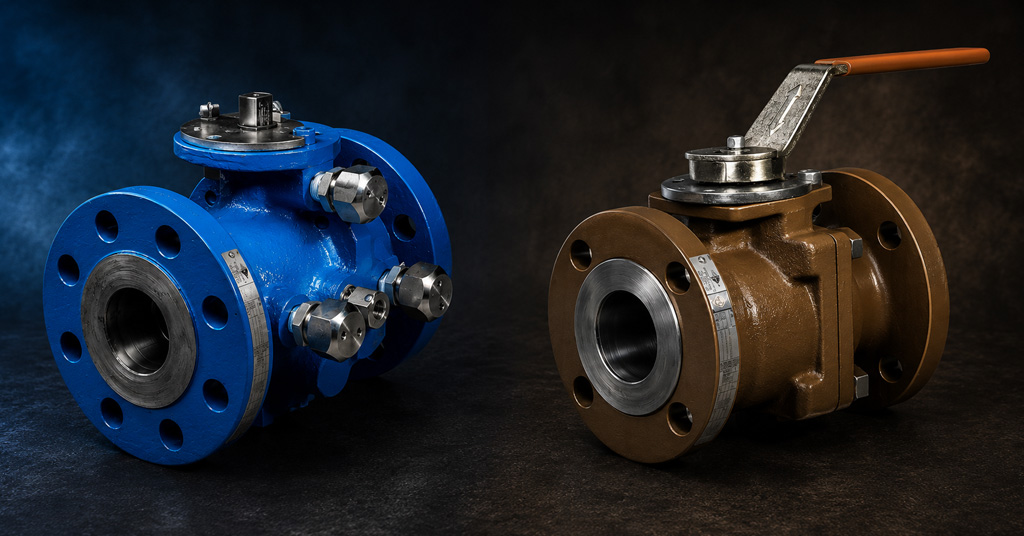
Choosing the right ball valve is about more than selecting a size or pressure class. The internal design of the valve plays a major role in how it performs under pressure, how much torque is required to operate it, and how well it holds up over years of service.
Two of the most common designs used in pipeline applications are floating ball valves and trunnion-mounted ball valves. While they may look similar from the outside, they are engineered differently and each offers unique advantages depending on the application.
Understanding the differences between these two valve designs can help engineers, operators, and procurement teams make more informed decisions for pipeline systems.
Understanding Ball Valve Design
At the heart of every ball valve is a spherical ball with a bore through its center. Rotating the ball one quarter turn allows flow to pass through the valve or shuts it off completely.
Where floating and trunnion ball valves differ is how that ball is supported inside the valve body.
That difference affects pressure capability, sealing performance, operating torque, valve size, and long-term reliability.
What Is a Floating Ball Valve?
A floating ball valve uses a ball that is not mechanically anchored at the top and bottom. Instead, the ball is held in place by the valve seats and is free to move slightly within the valve body.
When pressure is applied, the ball is pushed against the downstream seat, creating a tight seal that prevents leakage.
This simple design has made floating ball valves one of the most common choices across industrial applications.
Advantages of Floating Ball Valves
Floating ball valves offer several benefits, including:
- Compact and straightforward design
- Excellent shutoff performance
- Lower manufacturing cost
- Fewer internal components
- Reliable sealing in moderate-pressure applications
For many general industrial and pipeline applications, a floating ball valve provides dependable performance with minimal complexity.
Common Applications
Floating ball valves are commonly found in:
- Gathering systems
- Distribution pipelines
- Industrial processing
- Chemical facilities
- Utility services
- General oil and gas applications
They are an excellent solution when pressure levels and valve sizes remain within their intended operating range.
Limitations
As valve sizes and system pressures increase, so do the forces acting against the floating ball.
Higher pressure means greater seating loads, which can increase operating torque and place additional stress on internal components.
For these demanding environments, another design often becomes the preferred solution.
What Is a Trunnion Ball Valve?
A trunnion ball valve uses a ball that is mechanically supported by bearings or trunnions located at both the top and bottom of the ball.
Instead of allowing the ball to move under pressure, the trunnion support keeps it fixed in position while the seats move toward the ball to create the seal.
This design significantly reduces the force required to operate the valve, especially in larger sizes and high-pressure applications.
Advantages of Trunnion Ball Valves
Trunnion-mounted ball valves provide several important advantages:
- Lower operating torque
- Improved performance in high-pressure systems
- Better support for larger valve sizes
- Reduced seat wear
- Longer service life in demanding applications
These characteristics make trunnion ball valves a preferred choice for many midstream and transmission pipeline systems.
Common Applications
Trunnion ball valves are frequently used in:
- Transmission pipelines
- Compressor stations
- Pump stations
- LNG facilities
- High-pressure oil and gas systems
- Critical pipeline isolation points
When reliability under demanding operating conditions is essential, trunnion-mounted designs often provide the greatest long-term value.
Trunnion Ball Valve vs. Floating Ball Valve
Although both valve types perform the same basic function, their design differences make each one better suited for specific operating conditions.
| Feature | Floating Ball Valve | Trunnion Ball Valve |
|---|---|---|
| Ball Support | Free floating | Mechanically supported |
| Pressure Capability | Moderate to high | High pressure applications |
| Valve Size | Small to medium | Medium to large |
| Operating Torque | Higher as pressure increases | Lower and more consistent |
| Seat Loading | Pressure pushes ball into seat | Seats move toward fixed ball |
| Typical Cost | Lower initial investment | Higher initial investment |
| Best For | General industrial service | Pipeline and critical service |
Neither design is universally better than the other. The right choice depends on the application.
Which Ball Valve Should You Choose?
Selecting the correct valve begins with understanding the operating conditions.
A floating ball valve is often the right solution when:
- Valve sizes are smaller
- Operating pressures are moderate
- Simplicity is preferred
- Budget is an important consideration
A trunnion ball valve is typically recommended when:
- Pipeline pressures are high
- Larger valve sizes are required
- Reduced operating torque is important
- Long-term reliability is the priority
- Critical shutoff performance is required
Choosing the proper valve design helps improve system reliability while reducing maintenance costs over the life of the equipment.
Why API 6D Still Matters
Whether selecting a floating or trunnion-mounted ball valve, API 6D certification remains one of the most important considerations for pipeline service.
API 6D establishes rigorous standards for valve design, manufacturing, pressure testing, inspection, and quality assurance. Certification helps ensure that valves are built specifically for the demanding conditions found in pipeline applications.
If you have not already, be sure to read our guide, “What Is an API 6D Valve? A Complete Guide for Pipeline Applications,” along with “Why API 6D Certification Matters for Midstream Operations,” to learn more about how certification supports long-term pipeline reliability.
Frequently Asked Questions
Which is better, a trunnion ball valve or a floating ball valve?
Neither design is universally better. Floating ball valves are well suited for many standard industrial applications, while trunnion ball valves are generally preferred for larger sizes and higher-pressure pipeline systems.
Why do trunnion ball valves require less operating torque?
Because the ball is mechanically supported, pressure does not force it against the seats in the same way as a floating design. This reduces friction during operation and lowers the amount of torque required.
Are both valve designs available with API 6D certification?
Yes. Both floating ball valves and trunnion-mounted ball valves can be manufactured to meet API 6D requirements when intended for pipeline service.
Which valve lasts longer?
Service life depends on the application, operating conditions, maintenance practices, and valve quality. In demanding pipeline environments, trunnion-mounted designs often experience less seat wear due to their supported ball construction.
Final Thoughts
Both floating ball valves and trunnion-mounted ball valves have earned their place in modern pipeline systems. Each design offers proven performance when applied in the right environment.
Understanding how these valves differ allows engineers and operators to make better decisions based on pressure, valve size, operating conditions, and long-term performance goals.
At KF Valves, we offer API 6D pipeline valve solutions designed for the demands of today’s oil and gas industry. Whether your application calls for a floating ball valve or a trunnion-mounted design, selecting the right valve starts with understanding the application and choosing equipment engineered for dependable performance.